byalexandr
-
Posts
9,130 -
Joined
-
Last visited













Recent Profile Visitors
49,301 profile views




byalexandr's Achievements

-
Hey all, I am on my new dual ISP setup at home (AT&T Fiber plus Verizon 5G on a Cisco RV340). All is working well and I am actually taking advantage of the WAN failover currently as AT&T is down for another 8 hours or so. Since the Cisco router is just an Ethernet router, I have a Ubiquiti U6+ AP in the kitchen ceiling to provide WiFi to my home network. The kitchen is the best place to put it for wireless coverage, however I was still not getting that great of a signal all the way in my room and as a result my iPhone would frequently disconnect from the AP. I had an extra 8 port switch and cheap TP Link AP sitting around, so I hooked up my computers and the AP to it in my room and set a different SSID with lower transmission power just to get my own AP in my room and not have to worry about it disconnecting. However, upon doing so, it caused all of the Apple devices (and only the Apple devices, strangely enough) to not connect to the Internet anymore. Regardless if it was on my AP in my room or the Ubiquiti AP in the kitchen. I have plenty of IPs available on my DHCP server so I don't think it was an IP conflict, and some sites like Google would work while pretty much everything else would not. The only thing I can think of is that the APs were interfering with each other or something. The Ubiquiti is dual band with a single SSID, the 2.4GHz channel selection is on auto with 20MHz bandwidth, and the 5GHz channel selection is also on auto with 80MHz bandwidth (even though 160MHz is available I don't really want to mess with being in DFS channels or having some of the devices on the network not support DFS). Whenever I unplugged the TP Link AP, everything went back to normal. I am not sure what channels/bandwidth the TP Link was using, but does this situation sound like it was due to interference?
-
Just a last update - I was able to get everything working with the Cisco RV340. Quite the enterprise grade appliance and I like it very very much, was well worth the price and just plain works. I left it in failover mode instead of changing both WAN ports to a precedence of 1 which enables load balancing. From there I configured the network detection settings to ping the Google DNS (8.8.8.8) instead of the default gateway, as it is unlikely my gateway would be disconnected from the Cisco router but very likely the AT&T gateway could be disconnected from the Internet (and thus the Cisco would not see that the connection is actually down). I verified the failover is working by unplugging the AT&T gateway from the ONT so all is good. As far as the DHCP configuration and which subnets I used, whenever I put the ISP provided routers in bridge mode (passthrough), I noticed it just passes the public IP address over to the Cisco router (and I see these in each WAN connection on the Cisco admin interface), so it didn't really have any influence on what subnet the local network needed to be on. Regardless, I still changed the static IP and the DHCP server on the Cisco router to use 192.168.80.x as my work VPN uses the subnet it was originally using (just to avoid any weird issues). The Ubiquiti U6+ AP is very nice, I mounted it on the ceiling in my kitchen which is central in the house and it has good coverage of the 5GHz band and excellent coverage of the 2.4GHz band. It gets about 600-700Mbps down when close to the AP, and the LAN connection on my desktop PCs are fully saturating the Gigabit connection. Here is the media enclosure setup now (with the ISP provided gateways in other areas of the house): Hopefully I have very reliable Internet now that I have two ISPs and automatic failover. Took a while to figure it out but happy with the results.

-
 byalexandr changed their profile photo
 -
I've tried bypassing the gateway before too with a pfSense router that spoofed the MAC address of the gateway so it could authenticate with the separate ONT. I guess AT&T updated their firmware or something as I could not get the two to negotiate a connection and take the crappy BGW-210 out of the picture. Anyways, I got the home network mapped out - this is how I will run it: The Verizon gateway is upstairs in the 'game room' as that's where the 5G signal is best. The AT&T gateway is downstairs in the living room and is coupled to the ONT outside the house via SRV-2 inside the media enclosure in one of the closets. The Cisco router and Netgear switch are also inside the media enclosure and grab LAN from each of the ISP routers and send the LAN from the Cisco router to the switch and out to all the rest of the RJ45 jacks in the house. The yellow one going to the kitchen will have a PoE+ injector before it exits the media enclosure to the kitchen where I'll mount the Ubiquiti AP on the ceiling. Should be a pretty reliable setup so long as I can get each of the ISP routers and the Cisco router configured correctly.
-
I ended up buying a Cisco RV340 along with a Ubiquiti U6+ and a PoE+ injector for it. Should all arrive tomorrow and from the documentation it seems pretty simple to set up. I am still sort of lost on the IP address assignments and DHCP server. I understand now that only the router connecting both ISP gateways should have DHCP turned on, but I don't know if each ISP router should be on a different subnet or if it matters. I am going to leave the AT&T gateway on the 192.168.1.x subnet, but I am thinking of changing the static IP on the Verizon gateway to the 192.168.2.x subnet (currently it is still on 192.168.1.x subnet like the AT&T gateway, just a different default gateway IP) and then my DHCP server and subsequently all the devices on the network would be on the 192.168.0.x subnet. Passthrough mode on the AT&T BGW-210 seems to produce some very odd behavior, like it's not actually in passthrough mode. I can turn off DHCP and put it in passthrough mode but it will still assign out IP addresses as though it is still turned on (and on the same subnet, not on a fallback IP). Perhaps it was just because the lease hadn't expired yet but I'm not sure. The Verizon gateway was pretty simple and turned off WiFi and IP assignment automatically when I turned on passthrough mode.
-
Well after some more configuring it looks like the TP Link router (Festa FR365) has sh*t the bed. It stopped broadcasting WiFi outright and doesn't connect to LAN, even after restarting it multiple times and hard resetting it. I am going to return the router to Amazon; are there any recommendations for a good dual/multi WAN port router, preferably with NO cloud based controller (I really hate the Festa controller after attempting to use it) and with dual band (2.4 and 5GHz) WLAN? The WLAN is not 100% necessary as I can set up an AP but is preferable. I am looking at MikroTik routers as they feature ISP bonding (which is pretty much unavailable on any consumer grade/priced devices) which to me is a huge plus. Although most of their devices only have Gigabit Ethernet which would be the bottleneck anyways if I were to have an aggregate 1.3Gbps throughput.
-
I turned off DHCP on both (the AT&T router I had to disable it manually, but the Verizon router turned it off automatically once I turned on IP passthrough). However I am still just on the AT&T router network, my TP Link router is just a 'middle man'. The DHCP server on the TP Link router is on a different subnet (192.168.0.x) than the ISP routers (192.168.1.x) but I'm not sure if that's an issue or not. I still have Internet access when connected to the TP Link router, and can access both admin interfaces at their respective static IPs, but I cannot ping the public IP address of either ISP router.
-
Hey all, I decided to add a second ISP to my home network for WAN failover, and got a TP Link FR365 router to do so. Just for reference, I have AT&T Fiber (1Gbps) with a BGW-210 gateway as the primary WAN (WAN2 on the TP Link router), and Verizon 5G home internet (300Mbps) with an ARC-XCI55AX gateway as the secondary WAN (WAN/LAN3 on the TP Link router). I would like the TP Link router to, by default, use the AT&T ISP (WAN2) which has historically been unreliable, and when that drops connection it fails over to the Verizon ISP (WAN3). I put both ISP gateways in passthrough mode, but in the TP Link router settings, it is showing a local network IP address (192.168.1.xx) for each WAN port and not the public IP address being passed through from each ISP gateway. The connection 'works', but it is just as though the TP Link router is a 'middle man' between the primary WAN (AT&T gateway), as when I unplug the ONT from the AT&T gateway the WAN failover does not occur. I have no idea what changes I need to make to the devices' IP addresses and DHCP server settings. I was able to add the TP Link device to the Festa cloud based network management, where I set up the WAN failover and load balancing, but it is showing the device as offline in the Festa app so it is not propagating my balancing/failover settings. Any help would be much appreciated, particularly what I need to do as far as DHCP settings on each device, what to set the device static IP addresses to, etc.
-
Ah, I was hoping it would be able to bond both ISPs together to make a 1.3Gbps throughput. But as long as the failover works then that's all I need it to do. 1Gbps over the fiber connection is plenty fast. And this one has WiFi 6E which should yield higher speeds than the crappy AT&T BGW-210 gateway so I will probably see some improvements over wireless at least. If needed I can just connect to LAN at one of the routers that I need to access. Otherwise I don't think I will need to touch them at all. Thanks for the advice, hopefully it works well. Currently waiting on the router to arrive with Amazon.
-
This is the one I ordered: https://www.amazon.com/TP-Link-Festa-FR365-Self-Organizing-Seamless/dp/B0D8M44Q91
-
Awesome, yeah I just ordered a TP Link WiFi router that has WAN failover. I am pretty new to how it works, is there a lot of configuration to setup on the new router (besides the basic stuff like setting up the SSID and all) for the failover? Will it just default to the faster WAN connection or combine them for a 1.3Gbps throughput? And how does it recognize when one of the WAN connections are down and switch to the one that is working? Also, since I got the WiFi router, I can just turn off WiFi broadcasting on both of the individual routers and this one will broadcast on the 'combined' ISP network on a single SSID?
-
Hey all, I have been pretty fed up with the downtime I regularly get with AT&T Fiber (and the really crappy equipment they give you that is ancient and locked down), so I added Verizon 5G Home Plus to my house. For starters, this is the current setup: - AT&T Fiber is 1Gbps, currently wired to a 16-port switch and distributing LAN to each room in the house - Verizon 5G is 300Mbps, currently just by itself with a couple devices connected to WiFi that get better signal than from the AT&T router due to proximity My AT&T service regularly has couple minute long service interruptions throughout the day, and sometimes extended service interruptions that can last 1-2 days. In most cases all I can do is wait and hope AT&T resolves the issue. The Verizon 5G internet has historically been (when I had it in my old apartment) very reliable as it uses the cell towers, despite not being Gigabit speeds like the AT&T Fiber. Ideally, I would like all the devices (both over LAN and WiFi) to connect to one network that has both of the ISPs connected. By default, I want it to use the AT&T service since it is faster, but whenever there is a service interruption I want it to switch over to the Verizon 5G service. Is this possible? Is all I need a dual WAN port router? Would I need to plug in a WAP into the new router to have one WiFi network? I am pretty new to this stuff so I'm not sure how to make the best of utilizing both ISPs with the goal of minimizing downtime.
-
As another update - while I think the 4TB M.2 drive will suffice for storing video for now, I may end up getting two or more large capacity 2.5" SSDs and doing a RAID configuration. I also might add another 32GB kit since the mobo has 4 slots, but typically 32GB has been enough for me so we will see. RAM seems to be much cheaper than it used to be when I was still building PCs. Played some games on it last night and it runs great! CPU temps were well under control, GPU fans barely even spin up and even under load it's a super quiet machine. Much much faster than my ROG Z13 was (to be expected of course, but still).
-
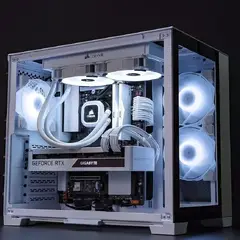
Just to update (typing from the new PC!) I ended up going with these parts: i7 13700K Gigabyte B760M Aorus Elite AX D5 Corsair Vengeance DDR5-6000 32GB (2x16GB) WD Black 1TB M.2 (OS/games drive) Inland 4TB M.2 (Storage drive) Gigabyte RTX 4060 Eagle OC 8GB Asus Prime AP201 Corsair RM750E Corsair H150i Elite Build was pretty easy, liking the case a lot even though the footprint is pretty large (might as well be just a shorter full size ATX tower). Very quiet, temps are looking good and the PC is lightning fast of course. I am finishing up installing all my apps and what not, and downloading R6 to test out the new GPU. Thanks for all the help!
-
I will consider an AMD processor for sure, as long as the productivity performance is up to par with the Intel offerings. This is the new list I came up with that uses mATX and 13th gen i7 right under $1500 (same RTX 4060 card): https://www.microcenter.com/site/content/custom-pc-builder.aspx?load=c037e544-67c8-42da-a413-6eb0094edc11 And to answer your question about files, normally they are around 200-300GB but it all depends on the length of the event. A private session following around one person is under 200GB of video, an entire day racing event can be even more than 400GB. Typically I film 1-2 events per month and keep the footage archived for at least 90 days. All of the footage is recorded on micro SD cards that I change out throughout the day as they become full - I then move all the footage over to my computer so Premiere Pro has fast read access and also add to that amount with the number of exported videos I create from the raw footage. I figure a 4TB M.2 SSD will suffice and if I really need more I can change it to a RAID setup with 2.5" SSDs later on (since this mATX case has a bit more flexibility than the other mITX I had on the previous list).
-
Since it is mainly for productivity and gaming loads come second, I don't think (from what I've briefly read) I would benefit from the 3D cache on the Ryzen chips. Although I would be fine I guess with having a 13th gen i7 over a 14th gen since I also read the difference between the two generations is marginal and is just the classic 'refresh' thing that Intel has done in the past. I can look at a different case for sure though. I just liked the vertical layout of the 2000D but the difficult to access I/O on the bottom might be a deal breaker anyways and I can probably deal with the larger footprint of more traditional ITX case. I would prefer mITX, but I definitely don't mind the 13th gen as mentioned above. I forgot to mention that WiFi (or at least Bluetooth) is a must for me since I use a Bluetooth mechanical keyboard (Logitech MX Mechanical mini). I'll put together another list and come back with the link for additional input. I agree the Micro Center PC builder is painfully slow but they don't list Micro Center on PCPartPicker so it's a manual process entering all the prices.