Volbet
-
Posts
5,591 -
Joined











Volbet's Achievements

-
After almost two years of waiting, and a pretty anti-climatic delivery and partial RMA in November, I finally have the Haverwork Theseua75 in my possession: Ever since using the SP111 I've had a soft spot for split keyboards, so getting a 75% keyboard with a split was must-buy back in 2024. It's a really neat piece of kit, which was surprisingly easy to build, with the entire project being pretty logical. The build quality and general quality control is really good. With the bottom part of the keyboard being clear polycarbonat, you should expect nothing else than a kit that won't put the structural integrity of the keyboard at risk. The keyboard is build out with an FR4 plate, HMX K01 switches and PBTFans Retro Dark Lights keycaps. The two accent keycaps are just standard Keychron artisan and a Slavun Red Devils metal keycap. The blank keys on the left side are no-name XDA-profile keycaps from AliExpress. I didn't really think the accent keys from the main set to fit the overall aesthetic, so I just used something I had laying around. The switches are quite nice, like all new HMX switches are, and offer an out-of-the-box experience that requires no modifications. They're just the right balance of tactile and easy to write on for an extended amount of time. As I use it at work, the numberpad is a necessary accessory. It's just a Keychron Q0, but strangely it does fit rather well, as the typing angle is pretty much dead on that of the Haverworks. One of the weird reasons why this took close to two years to deliver, is that the initial delivery back in November 2025 had some strange oversights. For example, the PCB lacked a diode for the NUHS key, so it didn't support ISO layout. The cables meant for connecting the USB C daughterboards also weren't included, and since they aren't standard, they, wile not impossible, were difficult to source yourself.

-
It might get me crucified in certain circles, but I decided to give the new-ish Wooting 60HE v2 a try: I really wanted to go with translucent keycaps, but finding a set that supports ISO, is blank and has support for the split spacebar was an exercise in futility. So here's my thrown together key set, consisting of some no-name translucent keycaps from Aliexpress for the majority of the keys, two spacebars from the Keycreative Nekoccino set and a novelty from the Milkyway Cultured set. I'm now looking for a 1.25u novelty, but that's for a different day. The switches are Gateron Sparks HE. They're exactly what you can expect from a hall-effect switch. They feel as fine to type on as a linear switch can and they're as good for playing games as the rest of the hall-effect switches you can buy. I will say that Wooting has stepped up the quality of their kits since the last time I messed around with them. Even if there are some choices that are downright baffling, especially in regards to the Alumaze case, it's overall a very good kit. Good god, that's a nice keyboard. I love the industrial design of he case, and I really wish Drop supported a wider array of layouts with their keycap sets. Both their LotR sets and the new Fallout sets look amazing. I've also been loving HMX switches lately. Their newer tactile switches are really solid.
-
I've gotten a few keyboards recently, both of which was on sale, which isn't too common in the custom keyboard market: The Resonance Opus 1: The keyboard is really interesting, as it's basically all plated in nickel, making it extremely shiny. I also thought it would be a fun keyboard to try a split backspace on. But I've honestly never worked with a more impossible keyboard. Firstly, the keyboard having ISO support is just a plain fucking lie. The included aluminum plate had to be filled down to actually support ISO enter and split left shift, and the PCB wasn't probably programmed to actually support switches in the ISO sockets. Actually, the PCB wasn't programmed properly at all, since the bottom part of the matrix was shifted one key over, so non of the keys were in their place. Tracking down the necessary files for either QMK or VIA/VIAL to reprogram the keyboard was a nightmare unto itself, especially since the files that are available were broken and basically unusable. After trials, tribulations and tears I did manage to make a working .JSON file to use with VIA, but that really shouldn't be necessary for a production product for the end-user to reverse engineer the files provided by the company behind the keyboard. No wonder Resonance seemingly aren't making keyboards anymore. But after making it work I kitted the keyboard out with KNC Black Jacket tactile switches. It's a pretty standard tactile switch. It's not too light and not too heavy, which seems to be the trend right now. The keycaps are GMK Cosmos, a really nice BoB set with a glittering effect. If nothing else they'll really helps in training you in touch typing. When the issues with the plate and the PCB was solved, it's actually a rather nice keyboard. it's obvious that it is an older design, but it's still a very heavy case, a gasket mount and it does sound really nice. The Mode Design SixtyFive: As is the case with all keyboards from Mode Design, you can customize almost all the aspects of the keyboard. This is spec'd out with a copper bottom and weight, polycarbonate top and a copper mounting plate. The PCB is a Smith & Rune V3 PCB, as I don't really like the PCBs from Mode Design, as they have soldered on standoffs. The switches are Cherry MX Clear switches, which have been lubed with Krytox 205G2, filmed with Deskey films and have been springswapped with some slightly lighter TX springs. For good or bad it's still feels and sounds like a Cherry switch after all that. They also still have the issues that all Cherry MX Clear switches suffer from, where they essentially become bonded with whatever keycaps you put on them. The keycaps are Signature Plastics SA Macrodata Refinement, a really nice ABS SA-profile set. I'm not too sure I like the color with the rest of the keyboard, but I'll give it some time. Mode Design keyboards are always really functional. They are playing it safe, but sometime you just need something functional and standard to create a good platform. And I do like that they offer various mounting systems, even if I always end up going with isolated top mount on their kits. I don't think I'll ever understand the point of hidden screws, when they're hidden from the bottom. It's not like I spend a lot of time looking at the bottom side of the keyboard. There are a couple of keyboards in my collection that has a similar system, where you have to remove keycaps and/or switches to unscrew the top case. it's quite annoying. is the Vertex Intro 100 a hotswap or solder PCB? In my experience a squeaking sound on either the press or the return of the switch can be down to two things: Spring that need lubing, which I have yet to experience on an HMX switch. But there's a first time for anything. On hotswap PCB, it can be down to the switch rubbing against the mounting plate. If the switch housing is POM or similar low-friction material, they can move slightly up and down in the mounting plate when pressed, which can result in a squeak similar to rubbing two balloons together.
-
Nothing like being brought out of my eternal slumber because I was apparently shortly shown in one of the most viral YouTube videos this year, with a post where I was quite wrong.
In hindsigt I misunderstood the question, not that it excuses it.
For those that don't know what the fuck I'm on about:
How's everbody else's Christmas going?
-
A lot of my pre-orders and group-buys have been delayed, so there haven't been a lot to update on the keyboard front. But I did just receiver the Riva V2 keyboard: It's a interesting board, although, it might just be interesting to me. The main reason I bought it, is because it's designed around being a plateless board, which mainly meant it was a pain in the ass to solder the switches. But it's also a WKL 60% keyboard that allows for a full sized right shift. Not something you see every day. The only thing kinda dishonest about the keyboard, is that it was marketed as being a leaf spring mounted keyboard. This isn't really true in anything but the most charitable interpretations, as it's mounted via some protrusions from the PCB, which isn't much of a spring. It's essentially a sandwich mount with the PCB being the mounting point rather than the plate. It's fine for me, as I prefer a stiffer typing experience, but if you expect a typing experience akin to Angry Miao or MM Studio, you're better off elsewhere. Another weird issue is the cable routing from the USB daughterboard to the main PCB. The cable is tightly routed through the bottom weight, and that lead to be cleanly breaking on of the cables, as it got caught between the weight and the bottom case. The switches are KNCKeys ClackBits switches, a linear switch with a very long 13.9 mm pole. They do need to to be lubed, but once that's done it's a very nice switch for the heavy-handed typist . The keycaps are ePBT x GOK Kuro/Shiro caps. I mainly bought them for being the only set I've seen, where the sublegend is also available on the international keycaps. So you don't have weird missing sublegends when you don't use an American ANSI layout. Bu the quality of the caps do lead a lot to be desired, as the longer modifiers are bent to hell. It's nothing some how water and force can't fix, but in 2024 it shouldn't be a problem. Edit: Yes, I have noticed that some of the switches are on crooked in the picture. It has since been remedied.
-
Finished my first delid of a CPU, and I don't even care what temperature benefits there might be to this. No amount of gain in performance is worth the amount of stress one feels when a CPU makes cracking sounds.
-
The clicky option from Matias are fine. They won't be as good as real Alps NOS White, Blue or Orange, but they'll do in a pinch. I use them in a Bardorf keyboard and have been perfectly happy with them. They reason they aren't as good as real Alps, is because the Matias design is based on the later, cheaper simplified Alps switches. While they're generally more reliable than older Alps designs, they aren't as satisfying to type on.
-
The match between the keycaps and the keyboard was actually a happy coincidence. I bought the keycaps a long time ago on sale, as I thought the KAM profile looked interesting to try. But as is often the case, I ended up never really doing anything with the keycaps after I got them. But once the Machina Orbit arrived, I thought the color was a near perfect match. Too good a match to not use them, anyway. I think the Gateron Melodics, like any clicky switch, is a compromise in terms of their sound. With any clicky switch it seems you have to give up certain qualities in order to gain others. The Alps-like click-leaf design of the Melodics is really nice compared to the Cherry click-jacket or the Kailh click-bar, as it as a more substantial click than the former and doesn't have the double click of the former. Further more, the Melodics also doesn't have the hollowness of the ZealPC Clickiez. However, the trade-off with the melodics is that the sound is much more high pitched than the aforementioned ZealPC Clickiez or something like the Kailh Box Jade/Navy/White Owl. Although, the Melodics do also have a much quieter click than either the ZealPC Clickiez or the any of the Kailh click-bar switches I've tried. But even with all that, I do think the Melodics sound just fine with the SP-111 R2. I think it might be down to both the semi-open design of the case and the SA keycaps I chose to use. It seems to create the right balance of openness and resonance to compliment the sound. But for the switches to truly shine, you probably need a true plastic case, made of either polycarbonate or ABS, with a lot of empty space inside. Basically make the keyboard into an acoustic guitar. I could imagine that the bottom-mounted aluminium plate you describe would give some strong metallic resonance when paired with a clicky switch. I always strongly preferred either carbon fiber, FR4 or PC plated for clicky switches. Or even better is a plate-less build. And some sort of isolating mount is a must, if the case isn't plastic. And as you mentioned, the tactility of the Melodics is really something else. It's basically a lighter version of Blue Alps, which is something I'm always glad to use. The tactility that a click-leaf offers is something that really can't be replicated by any other means. It's a snappy tactility that not even the heaviest of tactile switches can come close to. The closest I think I've found are the Wuque Studie Heavy Tactiles, but even those aren't a perfect match. My main criticism of the Melodics is that the actuation and the click don't match perfectly, as the actuation happens slightly after the click is activated. It's not really an issue that you experience with normal typing, but if you're one of those people that always keep your keys slightly pressed, that might be an issue. Yeah, I always found flex-cuts to be gimmick, which mainly serve to make your mechanical keyboard feel like a membrane keyboard. Flex-cuts also negatively affect the sound in my experience. One thing that could be interesting to try, would be to have some spacers 3D printed, so as to fit bigger gaskets on the plate. Akin to what Glorious did with the GMMK Pro, but without the need for a new bottom case. Experimenting with replacing the silicone socks with foam sounds really interesting. Poron foam should definitely create more flex, but you also need space for that flex to shine.
-
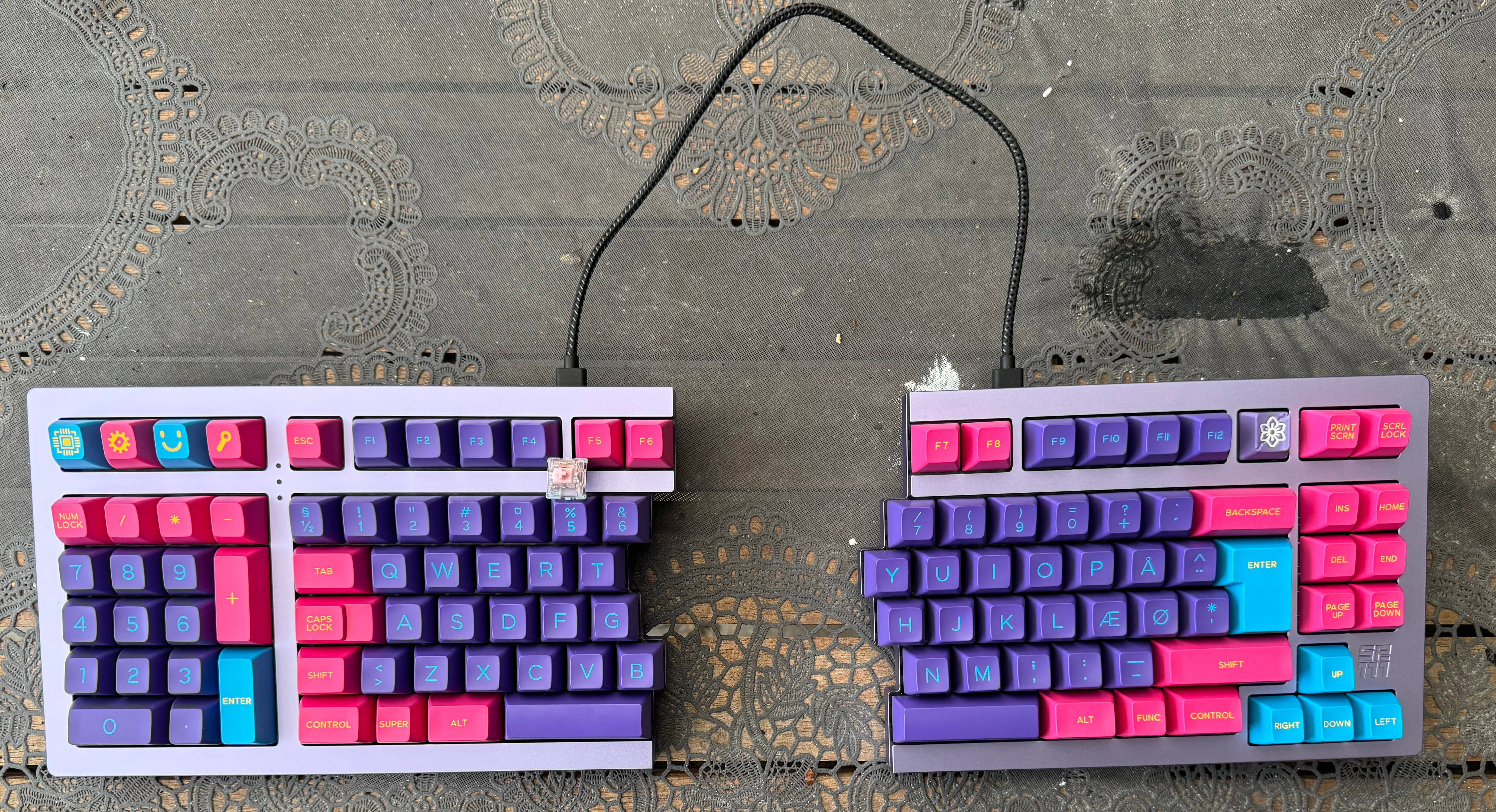
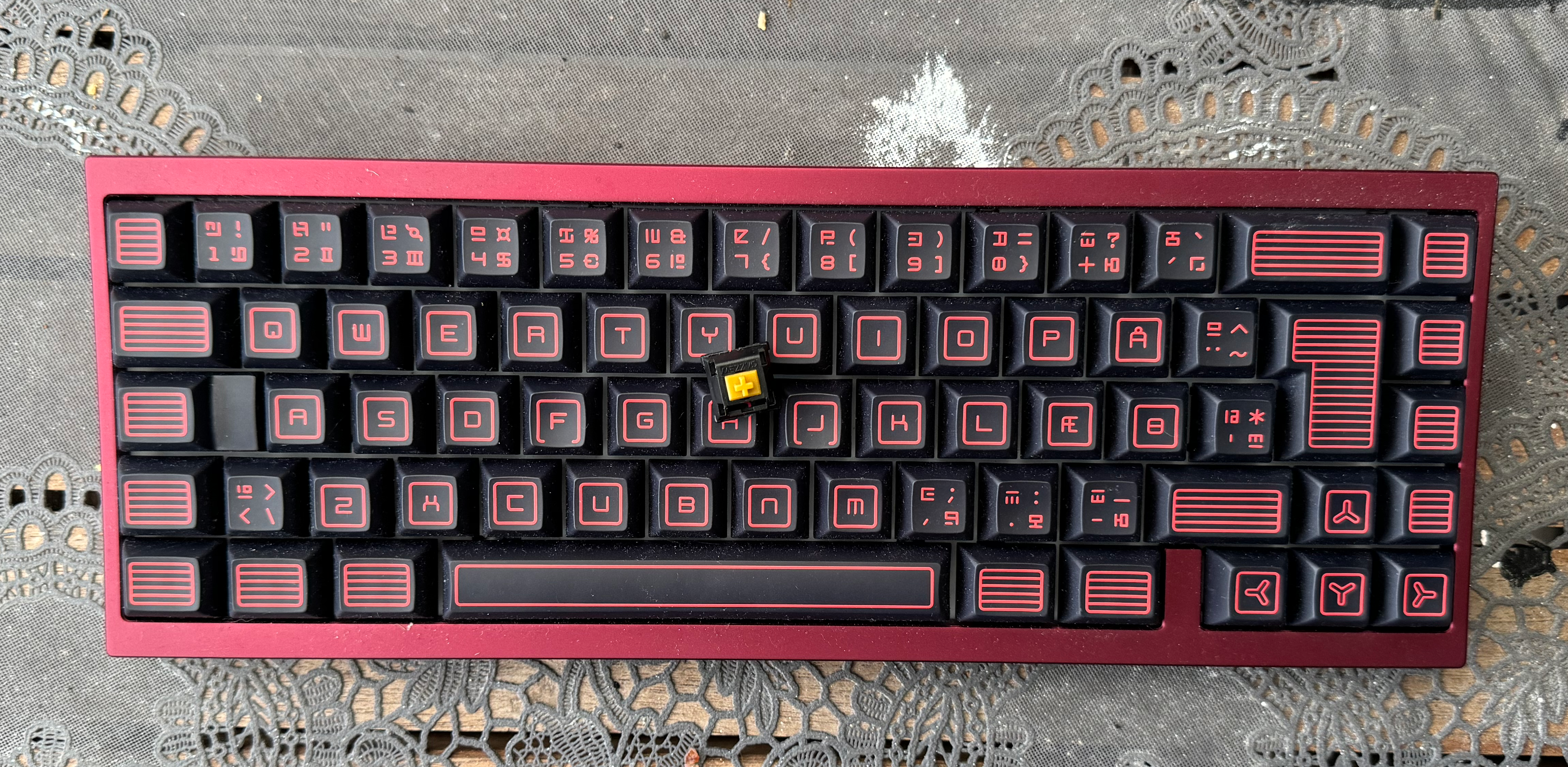
I guess I've been slacking in posting some of the group buys that finally have arrived: First up is the SP-111 R2 in lavender: I decided to build this out with Gateron Melodic switches, Durock V2 stabilizers (mainly because they came with 3U wires) and the keycaps are some Domikey SA Cyberpunk ABS caps. The switches are mounted to a (badly) modded carbon fiber plate. Modded in order for it to fit the ISO enter and the split left shift. As a solder PCB was the only choice, obviously the switches are all soldered in. And yes, it's a pain the ass to solder 111 switches, but I fear the day i might wanna try some different switches. This board is actually really fucking nice, and I know this is weird, but for me the best part is the dedicated caps-, scroll- and numlock indicator lights. it's something you see way too little on custom keyboards. It's also nice to have a custom keyboard with a numpad. And while not a roomy keyboard, it doesn't sound like it. I would honestly liken the sound of the keyboard more to old plastic keyboard than the modern customs made of metal. It sounds really good with the clicky switches. I do think a lot of the sound is down to the very isolating sandwich mount, where the plate goes all the way to edge of the case, creating a band around the entire keyboard. The only two bad thing I have to say so far is that: You have to reflash the firmware yourself in order for the keyboard to work properly. Else the keymapping is all over the place and VIA/QMK/VIAL won't recognize the keyboard correctly. Took the better part of two day to figure out what was wrong, but now it works perfectly and the keymapping is just like it should be. The recess for the USB cable (both for the computer connection and the connection between the two halves) is extremely shallow. So while I do wanna use a longer cable between halves, I can't fit any of the cables I currently have in my possession. Next up is the Machina Orbit in red with a copper bottom: This is a hefty 65% keyboard, weighing in at 2,55kg fully build with a POM plate. The switches used are Gazzew Boba U4Ts, which have had their springs swapped for a long 100g double springs. So it's an extremely heavy and very tactile typing experience, which you won't really find with any other switch. The switches have also been lubed with Tribosys 3204 and filmed with Deskey poron films. The plate is POM and the keycaps are KAM Command PBT caps, which are are sculpted, flat keycap profile. It uses TX AP stabilizers, which are my current favorite stabilizers to use, as snap-ins are so easy to install. The plate and PCB are mounted using rubber gasket in the tadpole-style. The only mod I've done to the board is the forcebreak mod. I don't really know if it was necessary, but I did it just to be safe. It's not like it's going to hurt. This is also a really nice board that doesn't really need any foam. it did come with both plate and case foam, but I opted to not use any of it. And the sound is really nice and full. Man, I'm jealous of that Zoom 98. It's one of those boards that I really wanted to try, but I just couldn't justify the price to myself. I've pretty much loved all the Wuque/Meletrix keyboards I've tried, but I have yet to actually own one. One day maybe... Also, the WS Morandi switches are some of my favorite linear switches. Considering their price, they're a bargin.
-
I also saw an issue in the smoothness rating, which I'm glad RTings did, as well. I think they're on to something with analyzing noise in a force curve, but my issue with that is, that they're essentially wanting to translate a subjective experience into an electrical signal. Noise in what should be a smooth signal will obviously tell you something about the development in the signal, but it will tell you nothing about how that noise feels to a person. As you said, different types of noise might feel different, even with slight differences in the noise. And that will probably be infinitely difficult to quantify.
-
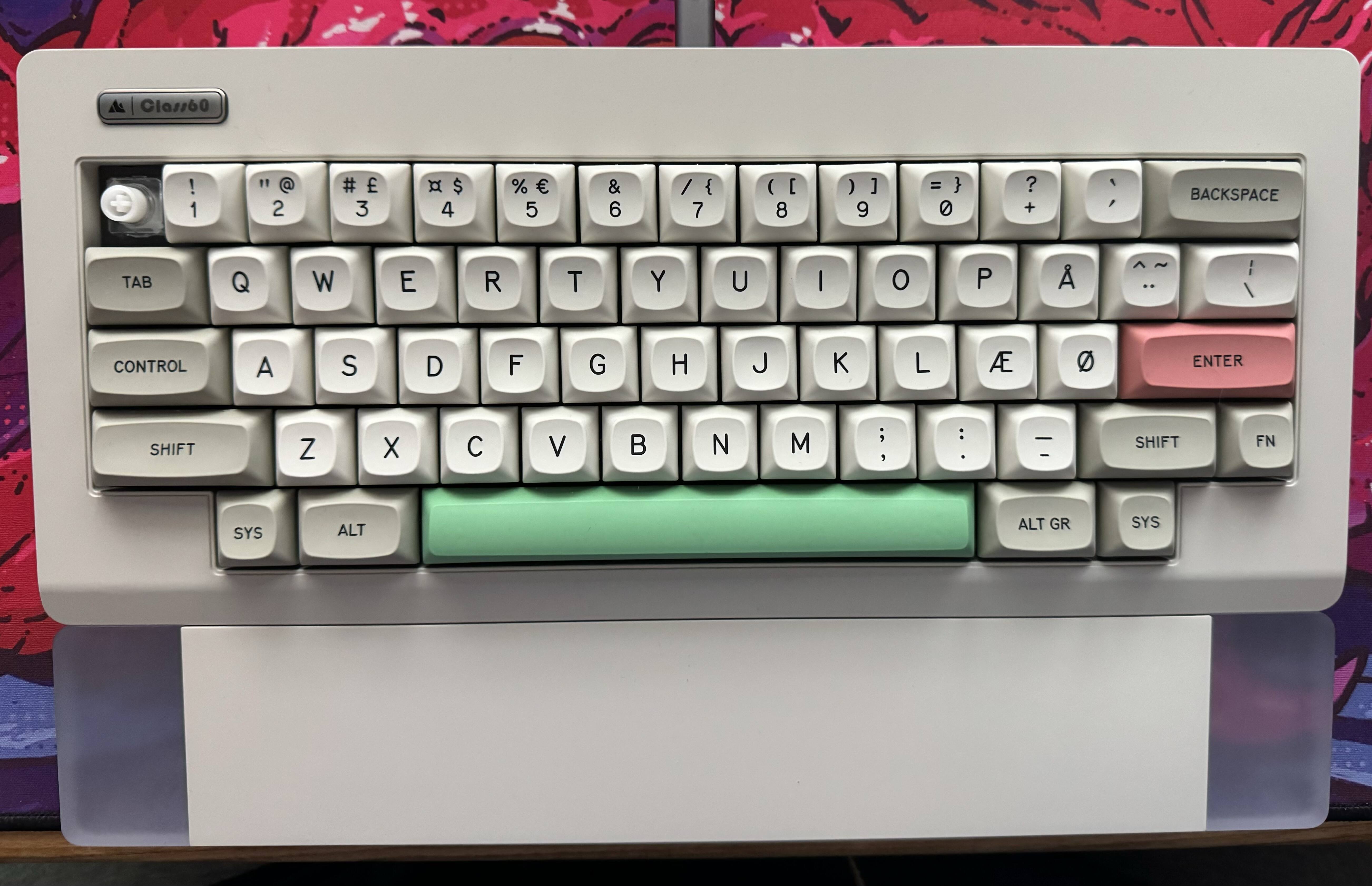
It's no secret that I liked the previous MMStudio keyboard, the Class80, so they didn't have to ask twice when they put up the group buy for the Class60 with electrocapacitive Topre-like switches. And only seven months later the group buy finally arrived: The switches are fairly light, which I do have to get used to, but the build quality of this keyboard is extremely good. It's the first keyboard that I haven't had to do the forcebreak mod to, which speaks to the quality of the aluminum used. It's also really nice sounding without any foam, which again speaks to the quality. The leaf spring mounting is also really nice, as it offers a pretty good middle point in stiffness between gasket mounting and top mounting. The keycaps are the beige version of the "new" GMK MTNU keycaps, which are basically Cherry profile keycaps sculpted like Drop's MT3 keycaps. They're also PBT, which makes them really nice for everyday use. As for typing, I think it's a bit too early to say. I do find them really nice to type on, but that might also be down to the electrocapacitive switches. My main criticism is that you can only use plate-mounted stabilizers if you use the electrocapacitive switches. It's not a deal breaker, but it's worth taking into account, if you're in the market for the extras that are now available. But if you throw in some Durock or Owlabs plate-mount stabilizers, you're going to have an experience very similar to PCB-mounted stabilizers- Especially if you Band-Aid mod the plate before installing the stabilizers. If you're in any way familiar with MMStudio's keyboards, you also know that they add a buzzer and a solenoid to them. Both are very much gimmicks, as you'll probably only turn them on to hear what they sound like and then promptly turn them off. I will say the solenoid does offer some pretty good haptic feedback to your typing, but it's probably not going to be enjoyable for long typing sessions. EDIT: Another really nice thing is that the keyboard supports VIAL, which is second only to VIA in regards to customizing your keyboard. Especially in a small keyboard like this, it's a must to have the ability to set up layers and macros, as you do lack a bunch of keys. I generally really like RTings' approach too reviews, so this is welcomed news. I do fear that keyboard enthusiasts, just like audiophiles, aren't going to be very persuaded by pure data, as a lot of the market seem to more concerned with the subjective side of the experience.
-
Yeah, six months is long wait, but I really wanted a Machina Orbit, so it was either missing out or waiting until the end of the fourth quarter of 2023. So waiting it was. But manufactures like Qwertykeys and Meletrix usually deliver their group buys within a couple of moths, so I agree that those are usually a really good value. Finding switches in the EU can be a bit of a challenge. Usually you'll have to shop around. Different stores will price different switches cheaper than other. Usually, I tend to go with either KeyGem, Candykeys, Maxgaming, Coffeekeys and Keebcats. Although, I have shopped at other vendors when needed. For a linear switch, I've recently been enjoying the Wuque Studio Morandi switch. A longpole linear switch that sell for around 35-45 Eurocent a switch. The cheapest I've found them currently was on Coffeekeys for 39 Eurocent a switch excluding shipping.
-
Yeah, the name of the QK100 is kinda misleading. The "100" is more so referring to it having 100 keys rather than it being a 100% layout. I don't remember where i read it, but producing a full-sized keyboard can apparently be exponentially more expensive than something like a TKL or 65%, as the CNC required isn't available everywhere, and the PCB takes quite a bit more to design and manufacture. There's also the price of entry for the consumer, as the price to populate a full sized keyboard is quite a bit more than a smaller keyboard. You not only have to buy more switches, you also have to buy more keycaps. Although, the recent influx of larger 96% and 98% custom keyboards makes me hopeful that we'll see full sized offerings sooner rather then later. Personally, I have realized that I'm more than happy with a 96% keyboard for work. I don't use the majority of the navigation keys, so loosing some of those aren't a big deal to me. The only learning curve is due to the keys I do use being moved around a bit.
-
I would agree on principle with buying a group buy rather than a Keychron. Even some of the cheaper boutique, in-stock option can offer more value. Something like the QK100 is a really likely a better value than something like the Keychron Q6. However, Keychron has the massive advantage of having little to no fulfilment time. I currently have group buys that are 6 months deep and having no date of final fulfilment yet. Only a vague quarter statement. I would also agree with @GarlicDeliverySystem that Keychron offering hotswap ISO support is a massive reason to get a Keychron. A lot of group buys only offer ISO on their solderable PCB options. For a beginner, or someone that likes experimenting with switches, that is a massive advantage. Believe me, desoldering a full-sized is a royal pain in the ass. The Gazzew (Boba) U4T switches are a personal favorite of mine. Although, I need to get some more at some point. The Boba switches I have is pretty much a Ship of Theseus situation, as only the stem and bottom housing remain of the original switch. Everything else has been replaced.
-
Unfortunately, all the Q- and Q-Pro series comes with is a thin sheet of film and a think layer of sparse foam. You can buy acoustic upgrade kits on Keychron's website, but I haven't had the opportunity to test those out yet. Going for the sound of metal case certainly could be case, but the quality of the machining doesn't really lend to a good sound, as my experience with both the Q6, the Q4, and the Q14 Pro has been that they ring like crazy. I guess it's a sound that someone will like, but it isn't for me. The ping that's prevalent on Keychron's metal cases can be remedied quite easily by the forcebreak mod, so they are workable, but it's still annoying that you need to mod a keyboard you just bought.