Jump to content

Dumb question about AMD cpu's

Go to solution Solved by Razzaa,

I'm still learning AMD, guys....  Why is it that AMD CPU max temps are way lower than intel's? Or should the question be why can intel chips go much higher...?

This is the best explanation. Voltage comes into play and is just as important as temps.


It all comes down to (1) the physics that underlie reliability and product lifetime, and (2) the physics that underlie the power-consumption of the CPU.

1. Physics that underlie reliability and product lifetime:

Thermally activated processes (remember the Arrhenius equation from your p-chem classes) will approximately double in rate for every 10°C higher the operating temp.

A cpu at 70°C will have roughly twice the operating lifetime as a cpu operated at 80°C.

During the technology node development phase, getting the intrinsic reliability of operating lifetime of the process technology is a major challenge. Our here in the public domain you mostly hear about yields, but reliability is an equally challenging issue during those 4yrs in which the node is originally developed.

Well, what can you do if you are running out of R&D time, your node needs to be put into production asap, but the one thing holding it back is that in its current form (hypothetically speaking) your Lifetime Reliability department is telling you that the chips will die in about 12 months of they are operated at 100°C?

The easiest thing to do is to just limit the max upper-temp to a value that enables you to hit your reliability target. 12 months at 100°C is too little? No problem, at 90°C that 12 months becomes a 2 years, at 80°C it becomes 4 yrs, at 70°C it becomes 8 yrs.

Now if your customers can be convinced to restrict their operating environment such that the CPU doesn't exceed 70°C, and an 8yr expected lifetime conforms with your warranty model and internal targets (10yrs is actually the norm for the industry), then you could just go to production and not worry about the extra 6-8 months it would have taken you to get the intrinsic reliability of your process technology up to the point that you could expect an 8-10yr operating life at 100°C.

This is where/how Intel decides what TJMax is going to be. 98°C is based on how operating temps effect operating life, if 97°C was needed then that is what they would have spec'ed it at, or 99°C, etc.

By the way, it is this "reliability margin" that we OC'ers are using up and using to our advantage when overclocking.

A chip that is built with a process tech that can intrinsically support an estimated lifetime of 10yrs at 98°C means you get 20yrs at 88°C, or 40yrs at 78°C, or 80yrs at 68°C.

Well none of us OC'ers really care to have our 2600K's last 40yrs or 80yrs, so we in turn up our operating voltages (increasing voltage, any voltage, decrease lifespan of the CPU) to such an extent that we basically spend our reliability budget on increasing the Vcc.

"Hot Carrier Damage" kills the transistors by degrading them over time. This happens at any voltage, but more voltage (and more current) makes it happen even faster.

Checkout this short article for a very very cursory review of some of the issues at play in device reliability (TDDB, Hot Carrier Damage, Electromigration)

So that chip which could be expected to last 40yrs at 78°C with 1.3V might only last 10yrs at 78°C at 1.4V, and only 2.5yrs at 1.5V and 78°C.

Increase voltage AND keep your operating temps high(er) is just using up your reliability budget all the faster.

This is why OC'ers pursue lower operating temps (although they may not know why they are doing such)...its not just about the power-bill or the noise...and it is part of the reason why extreme OC'ers go to vapor-phase, LN2, and LHe temperatures before putting 1.8V and so on through their CPU's.

But at the end of the day the reason for the max temperature difference between AMD and Intel CPU's comes down to the intrinsic reliability of those CPU's with respect to thermally activated degredation mechanisms.

Intel spent more money/time/effort to improve the intrinsic reliability of their process integration at those nodes respectively.

2. Physics that underlie the power-consumption of the CPU:

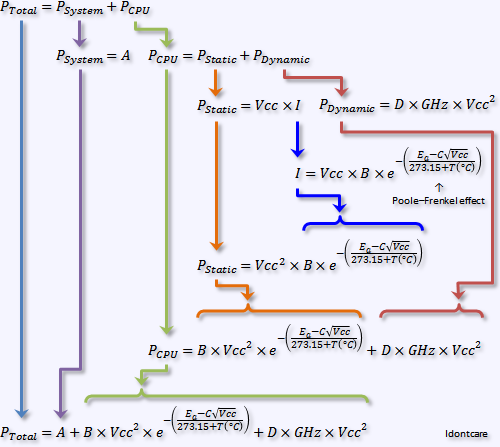
The second reason why the temperature maximum need be specified is adherence to the TDP spec. Power consumption from leakage in the silicon device is fundamentally dependent on the operating temperature of the CPU.

PtotalVccTGHz.png

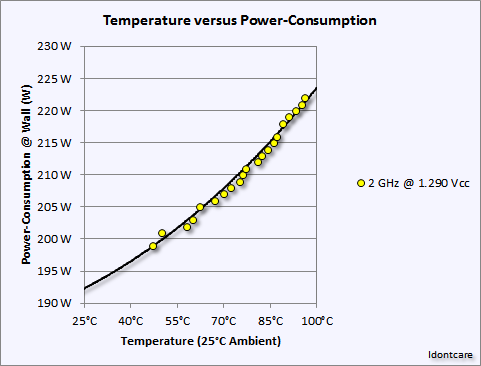
All else held constant (Vcc, clockspeed, etc), a hotter CPU will consume more power than a cooler one (see this thread).

TempvsPowerfor2GHzat1290V.png

So if AMD wants to spec their CPU's as being 125W TDP, for example, at a give clockspeed and operating voltage, if the max temp is 100°C then they have to dial down the clockspeed and/or Vcc such that when the CPU is at 100C it is not violating its own TDP spec because of the elevated leakage current.

My 2600K has a TDP of 95W, at 98°C the chip is burning through about 45W of just leakage (static power consumption) losses alone, but if I drop the operating temps to 68°C then the leakage power drops to 30W. That gives me a 15W TDP "surplus" to raise my clockspeeds while not exceeding the spec'ed TDP.

So AMD, by lowering their max allowed operating temperature spec, makes it easier on themselves to hit their reliability spec's as well as making it easier to bin their chips for higher clockspeeds and/or Vcc's while fitting them into the desired TDP bins.
 

I'm still learning AMD, guys....  Why is it that AMD CPU max temps are way lower than intel's? Or should the question be why can intel chips go much higher...?

Enthoo Primo - ASUS Maximus Formula VII - 4790k 4.8ghz 1.28v - EK Supremacy Evo Clean - 16GB Crucial Ballistix Tactical - 1000w EVGA Supernova Gold - 2x Alphacool Monsta Rads in push/pull - 2x Galaxy 780 HoF with EK waterblock
 
Build Log http://imgur.com/a/UV6Wh Just want to warn everyone, my build log is pretty mediocre.

Link to comment
https://linustechtips.com/topic/315157-dumb-question-about-amd-cpus/
Share on other sites

Link to post
Share on other sites

I'm still learning AMD, guys....  Why is it that AMD CPU max temps are way lower than intel's? Or should the question be why can intel chips go much higher...?

The die size on AMD chips are bigger, allow it to be cooled easier. And (forgot what it is called sorry) the part that make actual contact with the cores and die is higher quality on AMD, intel went the cheap route.

Link to post
Share on other sites

Well, I think it has to do with the quality of the chip.

Intel has its own fabrication labs so they can make chips to the best of their standards which, because they are the industry leader, are higher than most other silicon fabricators.

AMD has to have their chips made by other companies.

Link to post
Share on other sites

The die size on AMD chips are bigger, allow it to be cooled easier. And (forgot what it is called sorry) the part that make actual contact with the cores and die is higher quality on AMD, intel went the cheap route.

Its actually because of the types of materials used in intel chips that have a higher temperature tolerance.

It has nothing to do with one being better than the other, they are just made differently. Like AMD GPUs handling 95+C while nvidia throttling at 80C

NEW PC build: Blank Heaven   minimalist white and black PC     Old S340 build log "White Heaven"        The "LIGHTCANON" flashlight build log        Project AntiRoll (prototype)        Custom speaker project

Spoiler

Ryzen 3950X | AMD Vega Frontier Edition | ASUS X570 Pro WS | Corsair Vengeance LPX 64GB | NZXT H500 | Seasonic Prime Fanless TX-700 | Custom loop | Coolermaster SK630 White | Logitech MX Master 2S | Samsung 980 Pro 1TB + 970 Pro 512GB | Samsung 58" 4k TV | Scarlett 2i4 | 2x AT2020


Link to post
Share on other sites

The die size on AMD chips are bigger, allow it to be cooled easier. And (forgot what it is called sorry) the part that make actual contact with the cores and die is higher quality on AMD, intel went the cheap route.

this^ and intel just allow thier chips to go higher, I allow my fx8's to hit 70*c under prime95 because nothing will make it even get close to that.....except prime95.

that said im on a hyper 212 at the moment and have yet to break 55*c on the silent profile (~700rpm)

also intel know most of thier enthusiast cpus will be replaced in 5 years so they're not worried about losing a year or 2 of lifespan.

Falcon: Corsair 750D 8320at4.6ghz 1.3v | 4GB MSI Gaming R9-290 @1000/1250 | 2x8GB 2400mhz Kingston HyperX Beast | Asus ROG Crosshair V Formula | Antec H620 | Corsair RM750w | Crucial M500 240GB, Toshiba 2TB, DarkThemeMasterRace, my G3258 has an upgrade path, my fx8320 doesn't need one...total cost £840=cpu£105, board£65, ram£105, Cooler £20, GPU£200, PSU£88, SSD£75, HDD£57, case£125.

 CASE:-NZXT S340 Black, CPU:-FX8120 @4.2Ghz, COOLER:-CM Hyper 212 EVO, BOARD:-MSI 970 Gaming, RAM:-2x4gb 2400mhz Corsair Vengeance Pro, GPU: SLI EVGA GTX480's @700/1000, PSU:-Corsair CX600m, HDD:-WD green 160GB+2TB toshiba
CASE:-(probably) Cooltek U1, CPU:-G3258 @4.5ghx, COOLER:-stock(soon "MSI Dragon" AiO likely), BOARD:-MSI z87i ITX Gaming, RAM:-1x4gb 1333mhz Patriot, GPU: Asus DCU2 r9-270 OC@1000/1500mem, PSU:-Sweex 350w.., HDD:-WD Caviar Blue 640GB
CASE:-TBD, CPU:-Core2Quad QX9650 @4Ghz, COOLER:-OCZ 92mm tower thing, BOARD:-MSI p43-c51, RAM:-4x1GB 800mhz Corsair XMS2, GPU: Zotac GTX460se @800/1000, PSU:-OCZ600sxs, HDD:-WD green 160GBBlueJean-A
 CASE:-Black/Blue Sharkoon T9, CPU:-Phenom2 x4 B55 @3.6Ghz/1.4v, COOLER:-FX8320 Stock HSF, BOARD:-M5A78L-M/USB3, RAM:-4GB 1333mhz Kingston low profile at 1600mhz, GPU:-EVGA GTX285, PSU:-Antec TP550w modu, STORAGE:-240gb  M500+2TB Toshiba
CASE:-icute zl02-3g-bb, CPU:-Phenom2 X6 1055t @3.5Ghz, COOLER:-Stock, BOARD:-Asrock m3a UCC, RAM:2x2GB 1333mhz Zeppelin (thats yellow!), GPU: XFX 1GB HD6870xxx, PSU:-some 450 POS, HDD:-WD Scorpio blue 120GB
CASE:-Packard Bell iMedia X2424, Custom black/red Aerocool Xpredator fulltower, CPU's:-E5200, C2D [email protected]<script cf-hash='f9e31' type="text/javascript"> /* */</script>(so e8500), COOLER:-Scythe Big shuriken2 Rev B, BFG gtx260 sp216 OC, RAM:-tons..
Gigabyte GTX460, Gigabyte gt430,
GPU's:-GT210 1GB,  asus hd6670 1GB gddr5, XFX XXX 9600gt 512mb Alpha dog edition, few q6600's
PICTURES CASE:-CIT mars black+red, CPU:-Athlon K6 650mhz slot A, COOLER:-Stock, BOARD:-QDI Kinetiz 7a, RAM:-256+256+256MB 133mhz SDram, GPU:-inno3d geforce4 mx440 64mb, PSU:-E-Zcool 450w, STORAGE:-2x WD 40gb "black" drives,
CASE:-silver/red raidmax cobra, CPU:-Athlon64 4000+, COOLER:-BIG stock one, BOARD:-MSI something*, RAM:-(matched pair)2x1GB 400mhz ECC transcend, GPU:-ati 9800se@375core/325mem, PSU:-pfft, HDD:-2x maxtor 80gb,
PICTURES CASE:-silver/red raidmax cobra (another), CPU:-Pentium4 2.8ghz prescott, COOLER:-Artic Coolering Freezer4, BOARD:-DFI lanparty infinity 865 R2, RAM:-(matched pair)2x1GB 400mhz kingston, GPU:-ati 9550@375core/325mem, PSU:-pfft, HDD:-another 2x WD 80gb,
CASE:-ML110 G4, CPU:-xeon 4030, COOLER:-stock leaf blower, BOARD:-stock raid 771 board, RAM:-2x2GB 666mhz kingston ECC ddr2, GPU:-9400GT 1GB, PSU:-stock delta, RAID:-JMicron JMB363 card+onboard raid controller, HDD:-320gb hitachi OS, 2xMaxtor 160gb raid1, 500gb samsungSP, 160gb WD, LAPTOP:-Dell n5030, CPU:-replaced s*** cel900 with awesome C2D E8100, RAM:-2x2GB 1333mhz ddr3, HDD:-320gb, PHONE's:-LG optimus 3D (p920) on 2.3.5@300-600mhz de-clock (batteryFTW)
Link to post
Share on other sites

The die size on AMD chips are bigger, allow it to be cooled easier. And (forgot what it is called sorry) the part that make actual contact with the cores and die is higher quality on AMD, intel went the cheap route.

/facepalm

You can't be serious.  Hyperthreading is a market joke?


Link to post
Share on other sites

Its actually because of the types of materials used in intel chips that have a higher temperature tolerance.

It has nothing to do with one being better than the other, they are just made differently. Like AMD GPUs handling 95+C while nvidia throttling at 80C

 Are you sure? I am almost positive that I read that intel uses a crappy thermal contact material, which could be the reason why they design them to go higher. Example of the gpu's are spot on

(not being sarcastic lol, actually thought it was a great example).

Link to post
Share on other sites

 Are you sure? I am almost positive that I read that intel uses a crappy thermal contact material, which could be the reason why they design them to go higher. Example of the gpu's are spot on

(not being sarcastic lol, actually thought it was a great example).

No. There was only an issue with the old haswell CPUs not having good thermal paste.

2011-3 CPUs have the cover welded directly on the CPU die and they still have the same max temps as all the other intel CPUs.


To be fair though, the maximum recommended temps for intel CPUs is 75C as stated on the engineering specifications, but they can handle up to 105C without dying, and 85C is safe for 24/7 use

NEW PC build: Blank Heaven   minimalist white and black PC     Old S340 build log "White Heaven"        The "LIGHTCANON" flashlight build log        Project AntiRoll (prototype)        Custom speaker project

Spoiler

Ryzen 3950X | AMD Vega Frontier Edition | ASUS X570 Pro WS | Corsair Vengeance LPX 64GB | NZXT H500 | Seasonic Prime Fanless TX-700 | Custom loop | Coolermaster SK630 White | Logitech MX Master 2S | Samsung 980 Pro 1TB + 970 Pro 512GB | Samsung 58" 4k TV | Scarlett 2i4 | 2x AT2020


Link to post
Share on other sites

I'm still learning AMD, guys....  Why is it that AMD CPU max temps are way lower than intel's? Or should the question be why can intel chips go much higher...?

This is the best explanation. Voltage comes into play and is just as important as temps.


It all comes down to (1) the physics that underlie reliability and product lifetime, and (2) the physics that underlie the power-consumption of the CPU.

1. Physics that underlie reliability and product lifetime:

Thermally activated processes (remember the Arrhenius equation from your p-chem classes) will approximately double in rate for every 10°C higher the operating temp.

A cpu at 70°C will have roughly twice the operating lifetime as a cpu operated at 80°C.

During the technology node development phase, getting the intrinsic reliability of operating lifetime of the process technology is a major challenge. Our here in the public domain you mostly hear about yields, but reliability is an equally challenging issue during those 4yrs in which the node is originally developed.

Well, what can you do if you are running out of R&D time, your node needs to be put into production asap, but the one thing holding it back is that in its current form (hypothetically speaking) your Lifetime Reliability department is telling you that the chips will die in about 12 months of they are operated at 100°C?

The easiest thing to do is to just limit the max upper-temp to a value that enables you to hit your reliability target. 12 months at 100°C is too little? No problem, at 90°C that 12 months becomes a 2 years, at 80°C it becomes 4 yrs, at 70°C it becomes 8 yrs.

Now if your customers can be convinced to restrict their operating environment such that the CPU doesn't exceed 70°C, and an 8yr expected lifetime conforms with your warranty model and internal targets (10yrs is actually the norm for the industry), then you could just go to production and not worry about the extra 6-8 months it would have taken you to get the intrinsic reliability of your process technology up to the point that you could expect an 8-10yr operating life at 100°C.

This is where/how Intel decides what TJMax is going to be. 98°C is based on how operating temps effect operating life, if 97°C was needed then that is what they would have spec'ed it at, or 99°C, etc.

By the way, it is this "reliability margin" that we OC'ers are using up and using to our advantage when overclocking.

A chip that is built with a process tech that can intrinsically support an estimated lifetime of 10yrs at 98°C means you get 20yrs at 88°C, or 40yrs at 78°C, or 80yrs at 68°C.

Well none of us OC'ers really care to have our 2600K's last 40yrs or 80yrs, so we in turn up our operating voltages (increasing voltage, any voltage, decrease lifespan of the CPU) to such an extent that we basically spend our reliability budget on increasing the Vcc.

"Hot Carrier Damage" kills the transistors by degrading them over time. This happens at any voltage, but more voltage (and more current) makes it happen even faster.

Checkout this short article for a very very cursory review of some of the issues at play in device reliability (TDDB, Hot Carrier Damage, Electromigration)

So that chip which could be expected to last 40yrs at 78°C with 1.3V might only last 10yrs at 78°C at 1.4V, and only 2.5yrs at 1.5V and 78°C.

Increase voltage AND keep your operating temps high(er) is just using up your reliability budget all the faster.

This is why OC'ers pursue lower operating temps (although they may not know why they are doing such)...its not just about the power-bill or the noise...and it is part of the reason why extreme OC'ers go to vapor-phase, LN2, and LHe temperatures before putting 1.8V and so on through their CPU's.

But at the end of the day the reason for the max temperature difference between AMD and Intel CPU's comes down to the intrinsic reliability of those CPU's with respect to thermally activated degredation mechanisms.

Intel spent more money/time/effort to improve the intrinsic reliability of their process integration at those nodes respectively.

2. Physics that underlie the power-consumption of the CPU:

The second reason why the temperature maximum need be specified is adherence to the TDP spec. Power consumption from leakage in the silicon device is fundamentally dependent on the operating temperature of the CPU.

PtotalVccTGHz.png

All else held constant (Vcc, clockspeed, etc), a hotter CPU will consume more power than a cooler one (see this thread).

TempvsPowerfor2GHzat1290V.png

So if AMD wants to spec their CPU's as being 125W TDP, for example, at a give clockspeed and operating voltage, if the max temp is 100°C then they have to dial down the clockspeed and/or Vcc such that when the CPU is at 100C it is not violating its own TDP spec because of the elevated leakage current.

My 2600K has a TDP of 95W, at 98°C the chip is burning through about 45W of just leakage (static power consumption) losses alone, but if I drop the operating temps to 68°C then the leakage power drops to 30W. That gives me a 15W TDP "surplus" to raise my clockspeeds while not exceeding the spec'ed TDP.

So AMD, by lowering their max allowed operating temperature spec, makes it easier on themselves to hit their reliability spec's as well as making it easier to bin their chips for higher clockspeeds and/or Vcc's while fitting them into the desired TDP bins.

 

You can't be serious.  Hyperthreading is a market joke?


Link to post
Share on other sites

Instead of just /facepalm and being extremely unhelpful to what the OP asked, can you actually tell your reason why I am incorrect? I personally would like to know.

I posted the info, it just took some time.  :P

You can't be serious.  Hyperthreading is a market joke?


Link to post
Share on other sites

@Razzaa that is an amazing explanation and awesome too. Thank you very much

Enthoo Primo - ASUS Maximus Formula VII - 4790k 4.8ghz 1.28v - EK Supremacy Evo Clean - 16GB Crucial Ballistix Tactical - 1000w EVGA Supernova Gold - 2x Alphacool Monsta Rads in push/pull - 2x Galaxy 780 HoF with EK waterblock
 
Build Log http://imgur.com/a/UV6Wh Just want to warn everyone, my build log is pretty mediocre.

Link to post
Share on other sites

Also, AMD does not have a temp sensor per core like Intel. AMD uses 1 sensor per CPU. It has known to be off by anywhere from 10-15c.

oh jeez. interesting

Enthoo Primo - ASUS Maximus Formula VII - 4790k 4.8ghz 1.28v - EK Supremacy Evo Clean - 16GB Crucial Ballistix Tactical - 1000w EVGA Supernova Gold - 2x Alphacool Monsta Rads in push/pull - 2x Galaxy 780 HoF with EK waterblock
 
Build Log http://imgur.com/a/UV6Wh Just want to warn everyone, my build log is pretty mediocre.

Link to post
Share on other sites

I guess the lower max temp allows AMD to at least somewhat keep up with Intel. You see, if they rated their chips at 95 degrees as well they wouldn't be able to clock them as high as they do, because they wouldn't be stable at that temp, at that frequency.

I cannot be held responsible for any bad advice given.

I've no idea why the world is afraid of 3D-printed guns when clearly 3D-printed crossbows would be more practical for now.

My rig: The StealthRay. Plans for a newer, better version of its mufflers are already being made.

Link to post
Share on other sites

Thanks, actually read all of it, never knew that the sensor is 10-15c off.  lol that actually changes a lot. (Using AMD)

Starting with the Phenoms, AMD's digital sensor no longer reports an absolute temperature value anymore, but a reading with a certain offset, which is unknown. It is estimated that this offset is between 10 - 20c. They do get more accurate under load though.

You can't be serious.  Hyperthreading is a market joke?


Link to post
Share on other sites

Starting with the Phenoms, AMD's digital sensor no longer reports an absolute temperature value anymore, but a reading with a certain offset, which is unknown. It is estimated that this offset is between 10 - 20c. They do get more accurate under load though.


If the offset is unknown, how can you claim that the temperatures are more accurate under load?  Is it a positive offset or a negative one?

4K // R5 3600 // RTX2080Ti

Link to post
Share on other sites

 Are you sure? I am almost positive that I read that intel uses a crappy thermal contact material, which could be the reason why they design them to go higher. Example of the gpu's are spot on

(not being sarcastic lol, actually thought it was a great example).

Their TIM on Haswell and i believe ivy is pure bullshit. The reason why my xeon is running at 70°C on watercooling. Also AMDs temperature sensors dont really seem to work properly. My old athlon (yes this is very old) showed 9°C idle temps when room was 25°C, i have a friend who owns a 8150 and he gets like 5°C in idle sometimes, lol

My Rig: AMD Ryzen 5800x3D | Scythe Fuma 2 | RX6600XT Red Devil | B550M Steel Legend | Fury Renegade 32GB 3600MTs | 980 Pro Gen4 - RAID0 - Kingston A400 480GB x2 RAID1 - Seagate Barracuda 1TB x2 | Fractal Design Integra M 650W | InWin 103 | Mic. - SM57 | Headphones - Sony MDR-1A | Keyboard - Roccat Vulcan 100 AIMO | Mouse - Steelseries Rival 310 | Monitor - Dell S3422DWG

Link to post
Share on other sites

If the offset is unknown, how can you claim that the temperatures are more accurate under load?  Is it a positive offset or a negative one?

More info about what temps are important and how they are read.


What is "Core Temp" ?

"Core Temp" is what AMD refers to as "TCTL" and is a non-physical temperature on an arbitrary scale measured in degrees. It does not represent an actual physical temperature like die or case temperature.

What is "CPU Temp" ?

"CPU Temp" is read by a sensor in the socket of the motherboard.

It is a physical temperature and therefore will be effected by ambient temps inside the case.

Why should I use "Core Temp" and when?

AMD designed this equation to accurately read peak (45C+) and load temps. It has an equational offset to determine said temps which equalizes at 45C. Since it's designed for peak temps and is a non-physical temperature it cannot read idle temps or account for ambient temps correctly.

So what is "CPU Temp" good for then?

At peak temps this value is typically 7-10C higher (depending on motherboard) than the actual temp due to it being a physical sensor. At idle it's a little more accurate, but still not dead on, and besides idle temps do not matter near as much as load temps do.

AMD says my chip has a [iNSERT SPEC] Celsius limit, what value is this referring to? This limit seems kind of low, why?

This is referring to "Core Temp" of course.

So for example Phenom IIs have a recommended 62C "Core Temp" limit while not exceeding 60C for extended periods.

It has long been argued that the recommended limit is merely a larger safety net. There is a thermal shutdown in the chip at 90C and the silicone is rated for 97C+, so it seems plausable that we could indeed go higher, but this guide (and most in general) will simply *nod* and point you to the recommended limit for your chip.

What programs read "Core Temp" ?

AMD recommends the Core Temp program and AMD Overdrive for this reason.

The core section of HWMonitor also reads this value, but be careful as it also shows CPU Temp.


You can't be serious.  Hyperthreading is a market joke?


Link to post
Share on other sites

Create an account or sign in to comment

You need to be a member in order to leave a comment

Create an account

Sign up for a new account in our community. It's easy!

Register a new account

Sign in

Already have an account? Sign in here.

Sign In Now

×